
The Screen-Time Debate Is Asking the Wrong Question
Blogpost

Classrooms have added screens at remarkable speed. But putting a textbook on a tablet does not automatically make learning better.
The debate often gets stuck on whether screens are good or bad. I think we should ask a more useful question: What does a screen add to a lesson—and what might it be replacing?
My son is in first grade. He watches cartoons for about half an hour a day. The rest of his day has its own rhythm: school, playing outside, wrestling practice, swimming, and reading together before bed.
I’m there at wrestling, watching him listen, try a move, get it wrong, and go again. At swimming, I see that same patience take shape differently. At bedtime, he chooses the book. Since he started learning to write, I’ve noticed him reading faster, too. He’s always making up jokes and playing with words, often trying to make us laugh.
These are small, ordinary parts of our family life. But they make me think about what children need as they grow: time to move, practise, read, write, talk, play, and be with other people. A screen may support some kinds of learning. It can’t be the whole day.
Children don’t only learn by receiving information. They learn by trying things, noticing what happens, adjusting, and trying again.
Dr Ranko Rajović has argued that movement and play are important to children’s brain development. He has also warned about fast-paced video games and their reward cycles. Those are his views, and should be attributed to him rather than presented as settled proof that every game affects every child in the same way. Rajović’s comments on children, screens, and video games
The broader value of play is reflected in American Academy of Pediatrics guidance. Screen-free play can support children’s planning, problem-solving, language, social skills, movement, and confidence. The AAP also advises that media use should not displace sleep, exercise, play, reading aloud, or social interaction.
I see this in the activities that fill my son’s day. At wrestling, he listens, moves, and tries again. At swimming, he practises until a movement begins to work. Outside, he has room to invent a game and play it with whoever is there. At bedtime, a book gives us a reason to slow down, read together, and talk.
None of those experiences proves that screens are harmful. But they remind me that learning is not just content delivered efficiently. It also happens through movement, conversation, practice, and play.

Research on screens and learning is mixed. That makes the question harder, but it doesn’t make it less important.
In PISA 2022, students who reported up to an hour of digital-device use for learning at school scored higher in mathematics, on average, than students who reported no use. Students reporting heavier use scored lower. These are associations: they don’t prove that device use caused the score differences or explain what else might be going on.
So I wouldn’t use PISA to claim that screens are damaging every student. But I also wouldn’t treat the presence of devices as proof that learning has improved. Schools should ask what students are doing on screens, how the materials are designed, and what the technology adds to the lesson.
The same care is needed when we talk about falling reading scores. Across OECD countries, average reading scores dropped 10 points between 2018 and 2022. That is concerning, but the trend does not show that screens caused the decline. The OECD’s report on changes in performance gives the broader context.
The numbers give us a reason to investigate. They don’t give us a shortcut to a verdict.
Sometimes, it seems, yes.
A 2026 network meta-analysis compared reading comprehension on paper, computers, tablets, e-readers, and smartphones. Across the studies, comprehension was better on paper than on computers and smartphones; researchers found no reliable difference between paper and tablets. When digital text required scrolling, paper performed better than computers and tablets. When digital text was paginated and didn’t require scrolling, researchers found no reliable difference between print and digital.
The findings may apply most directly to college students reading English science texts. They don’t settle every question about younger readers or every kind of classroom material.
A review of 88 studies on children and adolescents found a similarly varied picture. Most studies found no difference in reading comprehension between print and digital. Print advantages appeared more often with informational texts and older children. Digital advantages appeared more often for engagement and some outcomes among younger children and diverse learners.
A student’s age matters. So do the text, the task, the page design, and the way the digital material works.
When my son and I read together, we don’t have to search for where we were or scroll back to find a detail. The page holds its place. We can see the words, the picture, and what comes next. When he writes, the page gives him room to put down his own ideas.
A well-designed digital page can also be easy to navigate. But when students have to read a long text by scrolling, it may be harder to keep track of where ideas sit and how they connect. That’s a design choice schools should take seriously.
For another perspective on this, watch Jared Cooney Horvath explain his “cognitive map” argument. He argues that the spatial cues of print can help readers navigate and remember text. Treat the video as his perspective, not a summary of the full research: studies comparing print and digital reading find that outcomes depend on the reader, task, device, and layout.

Digital tools can offer audio, adjustable text, translation, immediate feedback, collaboration, and interactive models. These features can help students access material or explore ideas in ways a printed page cannot.
A 2023 meta-analysis of mobile technology in primary and secondary education found positive average effects on learning outcomes. Results varied with factors such as teaching method, hardware, and the quality of the comparison. That supports purposeful uses of technology; it doesn’t show that more screen time is automatically better.
A screen can give feedback: it can mark an answer, offer another level, or show a model. But it can’t give every kind of response a child gets from another person. A teacher can notice hesitation. A coach can adjust a movement. A friend can react to a joke. A parent can stop at a word in a story and talk about it.
Screens can also bring physical considerations. Research reviews have found associations between prolonged device use and eye strain, lower physical activity, sleep concerns, and neck discomfort. Much of this research is observational. It doesn’t mean every child will experience these problems or that every screen activity causes them. It does make duration, breaks, posture, and what screen time may replace worth paying attention to. See the reviews on children’s digital-device health effects, neck pain and sedentary behaviour, and digital eye strain.
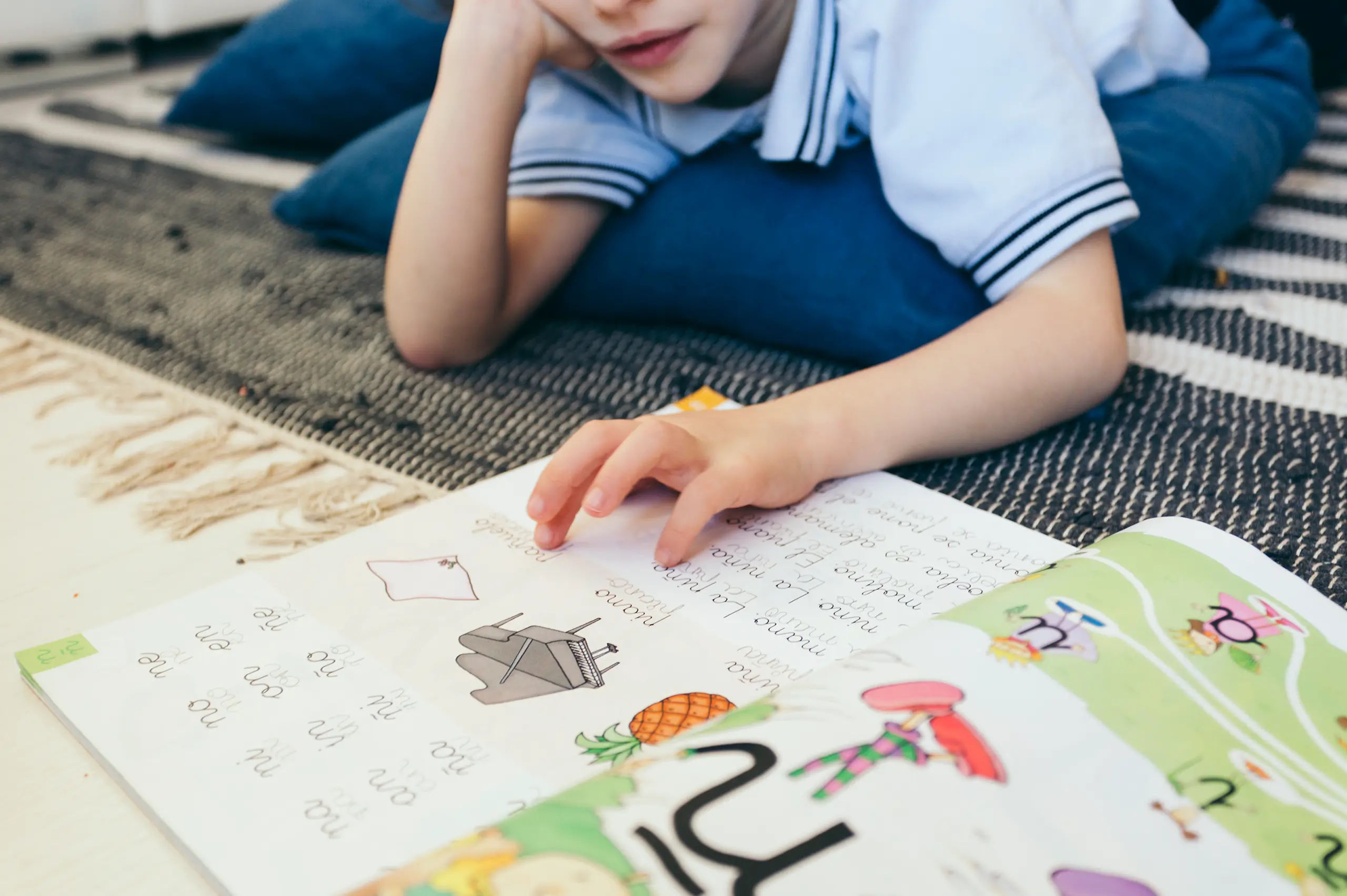
A textbook isn’t automatically good. A confusing page can frustrate a learner just as a confusing screen can. The design has to serve the learning.
But a physical book gives students a stable place to work. They can turn back, mark an idea, compare two examples, write out a solution, and see how a lesson is organised. The page stays where it is.
I’ve designed more than 50 educational books, including multi-level math and spelling programs. That work has shown me how much a well-structured page can do: help students know where to look, follow an explanation, connect an example to a problem, and find the idea again later.
My son’s experience with reading and writing makes those details feel concrete. As he learns to form letters and words, the act of writing is part of the learning. As we read together, he can point to a word, flip back to a page, or choose what comes next. The book is not just a container for content; it gives us something to work with together.
Digital tools can do valuable things too. The question is whether they add something the lesson needs—and whether that benefit is worth the time and attention they take.
I don’t want schools to reject every digital tool. I want them to stop treating screens as the natural destination for every lesson.
For a simulation that lets students explore a changing system, a screen may be the best tool. For extended reading, handwriting, or working through a sequence of problems, a textbook and pencil may serve students better. The right choice depends on what students need to learn and do.
But schools should ask more than, “Can we put this lesson on a screen?” They should ask:
Children need information, but they also need books, movement, practice, conversation, and play. Those experiences should not be crowded out just because screens are easy to distribute or measure.
A screen can support learning. It shouldn’t have to replace the rest of a child’s world.
How should schools balance screens with books, movement, writing, and play? What has helped children learn—and what might they be missing when more of the school day happens on a device?


